

Stephanie Houng
Postpartum Skincare Routine: A Japanese Minimalist Guide
I work directly with sake breweries in Japan to source Sake Kasu, the fermented rice ingredient INÉ is built on. This article cites peer-reviewed dermatology research throughout. For personal medical advice, speak to your dermatologist or OB.
In Japan, new mothers don't take a tub bath for about the first month after giving birth. The tradition has a name: Sango no Hidachi (産後の肥立ち). The rest period ends around day 21 with tokoage (床上げ), which means "rising from the bed."
After spending months around sake brewers in Niigata, I started noticing how Japanese culture treats the postpartum window. The questions Japanese mothers ask their midwives don't make it into Western skincare advice. So I went looking for the actual research.
Three things became clear. The hormones do most of the work. The routine should get smaller, not bigger. And a few specific ingredients carry more weight than the rest. Here's what I'd hand to a friend.
Summary and Key Takeaways:
Postpartum skin is a different animal than pregnancy skin. Hormones crash within days of birth. Your barrier thins. Breastfeeding pulls fluid for milk.
The shortest safe routine is five steps in under five minutes: gentle cleanse, ceramide moisturizer, one targeted serum, an occlusive seal, and mineral SPF. Skip retinoids and hydroquinone while nursing.
The Japanese have done postpartum skincare this way for centuries; small, gentle, and grounded in real science.
- Why does postpartum skin feel different?
- What's the safest postpartum skincare routine?
- Which ingredients are safe vs. unsafe postpartum (and while breastfeeding)?
- What's the best ingredient for postpartum melasma?
- When does postpartum skin go back to normal?
- What does Japanese postpartum tradition teach about skincare?
- When should I skip skincare and call a dermatologist?
- Postpartum skincare FAQ
Table of Content
Why Does Postpartum Skin Feel Different?

Three things compound. Estrogen and progesterone drop the moment the placenta is delivered. Your skin barrier thins. Water loss peaks about two months postpartum and returns to baseline by month six. Sleep deprivation drives cortisol up, which slows collagen.
Translation: drier, more reactive, sometimes breakout-prone skin. Usually temporary.
The Hormone Crash
Estrogen and progesterone keep skin plump and resilient during pregnancy. Both come mostly from the placenta. When it's delivered, both fall fast.
Estradiol climbs about 1,000-fold by the third trimester. Then it drops below pre-pregnancy levels within hours to days after birth (Hendrick et al., Psychosomatics, 1998).
The skin effect is what you'd notice from any sudden estrogen drop: dryness, thinning, sensitivity, sometimes acne.
TEWL peaks about two months after delivery.
Gallagher et al., Obstetric Medicine, 2014
The Barrier Shift
Transepidermal water loss (TEWL) measures how much moisture escapes through your skin. In a study that followed first-time pregnant women for six months after birth, TEWL rose through pregnancy and peaked two months after delivery, exceeding the normal range, before returning to baseline by month six (Gallagher et al., Obstetric Medicine, 2014).
That two-month window is when your skin needs the most support.
The Cortisol Effect
Sleep loss raises cortisol the next evening (Leproult et al., Sleep, 1997). High cortisol over time thins skin and breaks down collagen. It's the same mechanism behind the skin thinning you see from long-term steroid creams (Schoepe et al., Exp Dermatol, 2006).
Add the fluid demands of breastfeeding, and you have dry, fragile skin that hasn't slept enough in three months.
What's the Safest Postpartum Skincare Routine?

The simplest safe postpartum routine is five steps in under five minutes: gentle cleanse, ceramide moisturizer, one targeted serum (if you need it), a richer cream or oil to seal, and mineral SPF in the morning.
Skip stacking actives. On reactive skin, one well-chosen ingredient beats a cocktail of strong ones.
Step 1: Gentle Cleanse
Use a sulfate-free, pH-balanced cleanser, or a handcrafted soap that keeps its glycerin. Lukewarm water only. Alkaline soaps raise water loss with every wash, and the damage adds up (Voegeli, J Wound Ostomy Continence Nurs, 2008; Khosrowpour et al., J Cosmet Dermatol, 2019). Postpartum skin can't afford that.
Step 2: Hydrating Moisturizer with Ceramides
This is the barrier-repair workhorse. Ceramides make up about half of the lipids in your skin's outer layer (Coderch et al., Am J Clin Dermatol, 2003). Topical ceramides and glucosylceramides lower water loss in damaged skin. Pair them with a humectant.
Hyaluronic acid binds about 1,000 times its weight in water. The small molecules slip into the skin; the big ones seal the surface (Papakonstantinou et al., Dermatoendocrinol, 2012; Essendoubi et al., Skin Res Technol, 2016).
Step 3: One Targeted Serum (only if needed)
Pick one:
For tone, vitamin C (L-ascorbic acid) is required for your skin to make collagen, and it neutralizes UV-driven free radicals. It only works at the right pH (below 3.5), so the formulation matters (Pinnell et al., Dermatol Surg, 2001).
For dryness, hyaluronic acid. For melasma or breakouts, azelaic acid, which slows the pigment-overproducing enzyme and calms inflammation, with almost no systemic absorption (Searle et al., J Drugs Dermatol, 2022).
IMPORTANT NOTE: Stop there. Reactive skin doesn't tolerate the cocktail.
Step 4: Occlusive Seal
A richer cream or a thin layer of oil on dry areas locks in steps 2 and 3.
A 2024 dermatology review found that 24-hour occlusion can raise the water content of your skin's outer layer from 53% to 59% (Indian Journal of Dermatology, Venereology and Leprology, 2024). For oils, jojoba is closer to human sebum than to most plant oils, so it sinks in without clogging pores (Pazyar et al., G Ital Dermatol Venereol, 2013). Rosehip seed oil is high in linoleic and α-linolenic acid, the building blocks your barrier needs to rebuild itself (Lin et al., Int J Mol Sci, 2017).
Step 5: Mineral SPF 30+ (morning only)
Zinc oxide or titanium dioxide.
Mineral filters sit on top of the skin. They don't get absorbed into the bloodstream in any meaningful amount (Bozzo et al., Canadian Family Physician, 2011). This step matters most for melasma.
Without daily SPF, no brightening ingredient works. UV reactivates the pigment cells that pregnancy hormones primed.
Which Ingredients are Safe vs. Unsafe Postpartum (and while breastfeeding)?
Three families are safe across the board: humectants (hyaluronic acid, glycerin), barrier lipids (ceramides, niacinamide), and mineral sunscreens. Azelaic acid is the breastfeeding-safe workhorse for acne and dark spots.
Avoid retinoids, hydroquinone, and chemical sunscreens with oxybenzone.
The table below ranks ingredients by how much they get absorbed, using a peer-reviewed 2011 review.
Ingredient | Postpartum / Breastfeeding | Topical absorption | What it does (in plain language) |
|---|---|---|---|
Hydroquinone | ❌ Avoid | 35–45% | Skin lightener that absorbs deep into the bloodstream; not safe while nursing |
Glycolic acid | ⚠ Use cautiously | Up to 27% | A mild fruit acid (AHA) that loosens dead surface skin cells to speed up turnover |
Salicylic acid (low conc.) | ⚠ Use cautiously | Up to 25% | An oil-soluble acid that slips into pores and dissolves the “glue” holding dead skin cells together, clearing congestion |
Oxybenzone (chemical SPF) | ⚠ Avoid | Up to 8.7% | A chemical UV filter that absorbs into the skin and may disrupt hormones |
Benzoyl peroxide | ✅ Safe | ~5% (then metabolized) | Releases oxygen on the skin to kill acne bacteria; mostly stays at the surface |
Dihydroxyacetone (self-tanner) | ✅ Safe | ~0.5% | Reacts with the outermost dead-skin layer to create a tan-like color; doesn't penetrate further |
Topical tretinoin (retinoid) | ❌ Avoid (precaution) | Very low | A strong vitamin A derivative; a handful of birth-defect case reports keep topical use on the avoid list during pregnancy and nursing |
Topical clindamycin | ✅ Safe | Not detected in plasma | An antibiotic that kills acne-causing bacteria on the skin |
Topical erythromycin | ✅ Safe | Not detectable in serum | An antibiotic that kills acne-causing bacteria on the skin |
Azelaic acid | ✅ Safe | Minimal | Slows the enzyme that overproduces dark pigment, and calms inflammation. The workhorse for postpartum melasma and acne |
Niacinamide | ✅ Safe | Minimal | A form of vitamin B3. Evens tone by blocking pigment from moving between skin cells, and helps rebuild the skin barrier |
Hyaluronic acid | ✅ Safe | Negligible | Pulls water into the skin and holds it there (about 1,000× its own weight) |
Vitamin C (L-ascorbic, ≤15%) | ✅ Safe | Minimal | Required for collagen-building; neutralizes free radicals; gradually helps fade dark spots |
Ceramides + glucosylceramide | ✅ Safe | Negligible | Skin-barrier fats that replace what's depleted postpartum, cutting down water loss |
Mineral SPF (zinc, titanium) | ✅ Safe | None significant | Sits on top of the skin and bounces UV rays back, like a tiny mirror |
Absorption figures from Bozzo P, Chua-Gocheco A, Einarson A. Safety of skin care products during pregnancy. Canadian Family Physician 2011;57(6):665–7. The same review remains the most-cited reference in current pregnancy-skincare literature.
Recommended Reads 🌾

What's the Best Ingredient for Postpartum Melasma?

Azelaic acid is the workhorse. It's pregnancy- and breastfeeding-safe, slows the pigment-overproducing enzyme, and calms inflammation.
Pair it with daily mineral SPF 30 or higher. Vitamin C (at 15% or less) and niacinamide stack safely on top.
Hydroquinone is the standard prescription brightener, but 35 to 45% of it gets absorbed into your body, so it's not for nursing.
In a Brazilian study, pregnancy was the reported trigger for 36.4% of melasma cases. The mechanism: melasma happens when pigment cells go into overdrive under hormonal triggers.
Azelaic acid slows tyrosinase, the enzyme those pigment cells use to make melanin (Searle et al., 2022).
Niacinamide works at a different step. It blocks pigment from being passed to surface skin cells (Hakozaki et al., British Journal of Dermatology, 2002). That's why the two stack well.
Vitamin C neutralizes UV-driven free radicals and helps suppress the same enzyme. None of these are a substitute for SPF.
In a case-control study of 302 Brazilian women with facial melasma, pregnancy was the reported trigger in 36.4% of cases (Tamega et al., J Eur Acad Dermatol Venereol, 2013). Up to 30% of pregnancy-related melasma sticks around long-term.
Some studies have seen it persist 10 years postpartum (Handel et al., An Bras Dermatol, 2014).
IMPORTANT NOTE: Daily SPF is non-negotiable.
When Does Postpartum Skin Go Back to Normal?
Most postpartum skin changes settle within 6 to 12 months.
- Water loss returns to baseline around month six.
- Hormonal acne usually improves by months four to six, once your cycles regulate.
- Postpartum hair shedding starts around month three and usually resolves by month twelve.
-Melasma is the slowest. Without daily SPF and targeted treatment, it sticks around long-term in about 30% of cases.
A note on hair shedding: postpartum telogen effluvium (sometimes called telogen gravidarum) affects roughly a third to half of new mothers.
It usually begins two to three months after birth, peaks around four to five months, and resolves within six to twelve months (Hughes & Saleh, StatPearls, 2023; Gizlenti & Ekmekci, J Eur Acad Dermatol Venereol, 2014). It's a temporary cycle reset, not a sign something is wrong.
What Does Japanese Postpartum Tradition Teach About Skincare?

Japan has a centuries-old postpartum framework called Sango no Hidachi (産後の肥立ち). Culturally, it's a recovery period that ends at around 21 days (床上げ, tokoage, or "rising from the bed"). Medically, it's the 6 to 8-week 産褥期 (sanjokuki).
Traditional practice has restricted full-body tub bathing for about a month, though Japan's National Center for Child Health and Development is now re-examining that.
The cultural logic is gentle, patient, rice-grounded care, not fast intervention.
Two adjacent Japanese traditions inform postpartum skincare without being formally linked in historical texts.
Sango no Hidachi (産後の肥立ち) is the recovery framework. The traditional 21-day rest ends in tokoage, "rising from the bed." Modern Japanese medicine treats the matching sanjokuki (puerperium) as a 6 to 8-week recovery window. The "no tub bathing for one month postpartum" tradition is real, and Japanese obstetricians still reinforce it.
But a 2026 study from Japan's National Center for Child Health and Development, published in International Journal of Gynecology and Obstetrics, found that allowing early bath access did not increase rates of uterine or perineal wound infection.
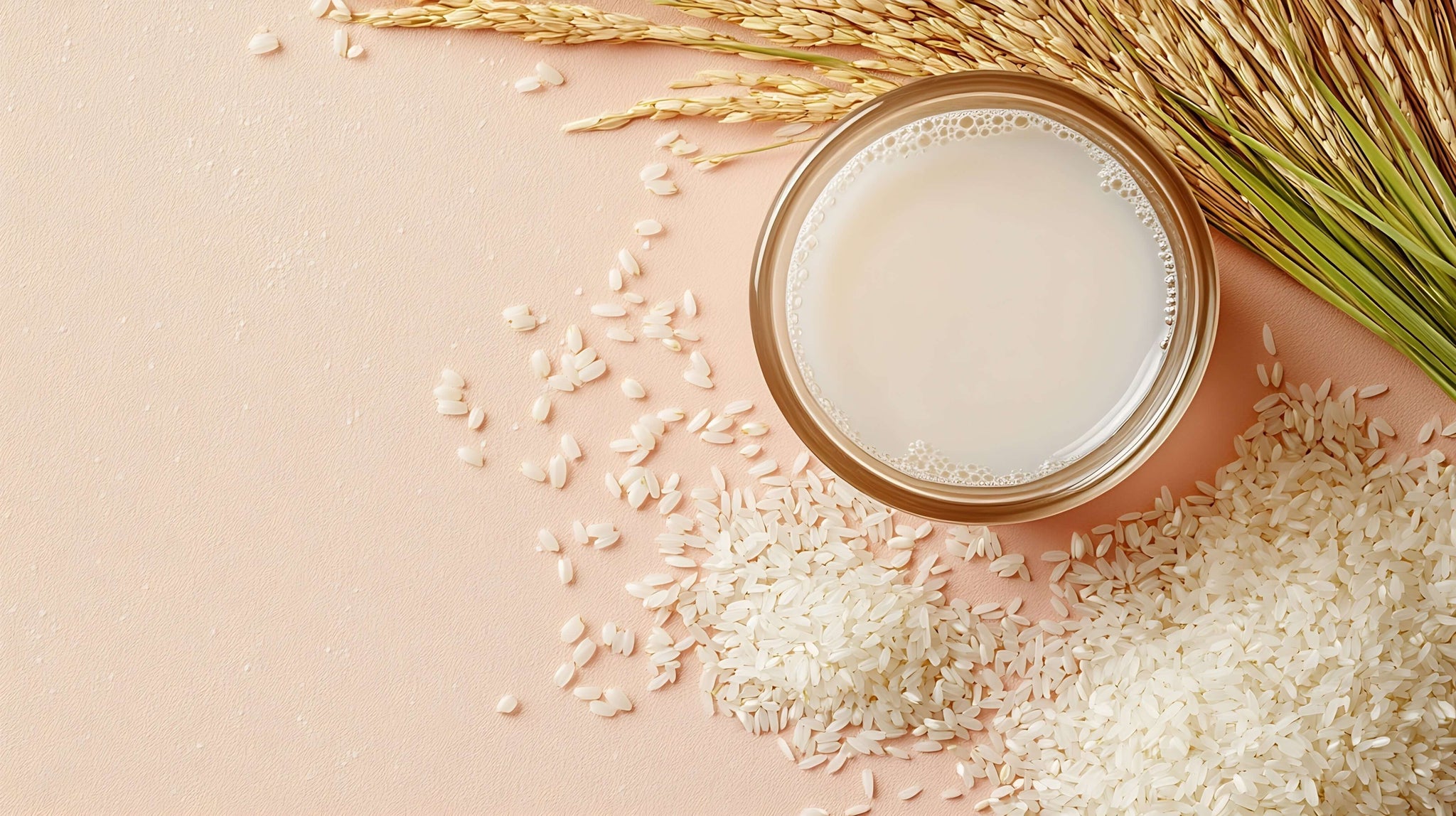
Komenuka (米ぬか / rice bran) skincare is older and separate. Edo-period women used silk and cotton pouches filled with rice bran, called nukabukuro, to gently cleanse the face and body. The practice is documented in the 1813 beauty manual Miyako Fūzoku Kewaiden (都風俗化粧伝). It's also researched today by the Pola Cultural Research Institute, Japan's most established cosmetics-history authority. Earlier still, in the Heian period (794–1185), court women used togi-jiru (米のとぎ汁), rice rinse water, mostly for hair.
The two traditions don't formally prescribe each other. But they share a logic. In Japan, postpartum recovery and skincare are both treated as patient, rice-grounded practices, not fast interventions. That's not folklore. It's a thousand years of accumulated practice making the same point modern dermatology now confirms. Less, but better-chosen, beats more. It's also why we wrote our Japanese minimalist skincare guide and traced the full history of fermented rice in Japanese beauty on The Research.
This is the philosophy behind the Skin Nutrient Bar I built. One Sake Kasu soap, used in place of six separate products in a postpartum routine that doesn't have time for six steps. The compounds inside include Lactobacilli (a probiotic that rebalances the skin's microbiome), Glucosylceramide (a precursor that speeds up ceramide repair), and GABA. No retinoids, no hydroquinone, no chemical sunscreen.
“The Skin Nutrient Bar has been a game-changer for my schedule as a working mom. It saves me time but also makes my skin look and feel the best it's been in a while.”
Sara Davis, New York City
INÉ Skin Nutrient Bar: Your Key to Unlocking the Ageless Beauty of Fermented Rice Water!

Introducing the INÉ Skin Nutrient Bar
An Artisan Soap Bar Made with Japanese Sake
Immerse yourself in the transformative power of fermented rice with the Skin Nutrient Bar, meticulously crafted with 100% organic Sake Kasu, a legendary secret from ancient Japanese skincare rituals.
Each bar, lovingly crafted to preserve the full, potent benefits of Sake Kasu, is designed to cleanse, nourish, and rejuvenate your skin from head to toe—all in the meditative mist of your shower. Just as the Toji's hands glow from daily immersion in sake, your skin too can embrace the radiant benefits of sake.
- Free from Harmful Additives
- Vegan Friendly
- Non-Comedogenic
- Safe For All Skin Types
- No Artificial Coloring or Fragrance
When Should I Skip Skincare and Call a Dermatologist?

Skin care plateaus when something deeper is going on. Call a dermatologist if any of the following show up:
• Postpartum acne hasn't improved after 8 weeks of consistent gentle care
• Melasma is spreading, painful, or aggressively dark
• You suspect PUPPP, cholestasis of pregnancy, or pemphigoid gestationis (any pregnancy-specific dermatosis with severe itch, jaundice, or vesicles)
• Hair loss continuing past 12 months postpartum, or unusually aggressive shedding
• Any rash that's painful, blistering, oozing, or rapidly spreading
• Any skin change with jaundice, fever, or sudden mood changes; escalate immediately to your OB or primary care
This is not the routine's job. Skincare can support postpartum recovery; it can't diagnose or replace medical care. Related: if you have sensitive or eczema-prone skin postpartum, our guide on gentle cleansing for sensitive skin goes deeper on barrier repair.
Postpartum skincare FAQ
Conclusion
Postpartum is the season where less actually is more. Not because you don't deserve a full routine, but because your skin needs a few well-chosen ingredients used consistently, not eight strong ones used inconsistently. The Japanese figured this out about a thousand years before the rest of us did.
If this was useful, I write more about Sake Kasu, Koji, and rice-based skincare in The Research at madewithine.com.

Unlock Radiance from Your Kitchen! Achieve a Glowing Complexion in Just 14 Days.
Easy ways to see if your skin is getting all the nutrients it actually needs? Get the Ultimate Guide to Using Rice for Better Skincare
- Learn how to create your own rice water serum.
- Step-by-step guide on creating your own fermented rice body and face mask.
- Get your soak on, and learn how to whip-up a Sake-tastic bath bomb.
- Plus 27 pages chock full of minimalist skincare tips!